Study Routine: A Weekly Rhythm You Can Restart Any Monday
Study routine: build a weekly rhythm around classes, short study tasks, and open time, then move unfinished work instead of scrapping the whole plan.
By Ultimate Student Planner by Cosmo Suite · Editorial policy
Published · 7 min read

It's Sunday night. Your notes are open, three assignments need attention, and the study plan you made last week has quietly become historical fiction. A study routine works better when it gives you a way to restart. Ultimate Student Planner is a Google Sheets and Excel planner by Cosmo Suite. Its student planner spreadsheet can hold dates and study sessions, while your syllabus and instructors tell you what to work on.
The fix is not to schedule every hour or promise you'll never miss a session. Build a repeatable weekly check around real commitments, clear tasks, and open time. When the week goes sideways, move the work that still matters and let the rest go. Monday is a useful reset point, but it isn't a magic one.
The Short List (TL;DR)
- Start with deadlines and fixed commitments, then count the time that remains.
- Turn broad subjects into small tasks with a source and a finish point.
- Leave open space for a longer task or an unexpected change.
- If you miss a session, reschedule the task or revise it. Don't rebuild the whole routine.
A study routine starts with the next real week
A study routine is a short planning check that connects course tasks to the time you can protect. It helps you choose a next action instead of filling your calendar for show.
Start with the week in front of you. Write down classes, work shifts, appointments, travel, and other commitments that already have a time. Add due dates from each syllabus or course site. If dates conflict, confirm them with the instructor or official course page before building a plan around them.
Now look at the open spaces. You do not need to use every one. Pick a few study windows that fit your energy and setting. A 30-minute block before dinner may be more realistic than a vague four-hour stretch after a full day of classes. The right amount depends on your courses and week.
Then name the task. “Study chemistry” could mean anything. “Work questions 1 to 4 from the review sheet, then check the answers” gives you a way to start and a way to stop. If the course material is unclear, write down the question you need to ask rather than adding another generic study block.
A weekly study rhythm, class by class
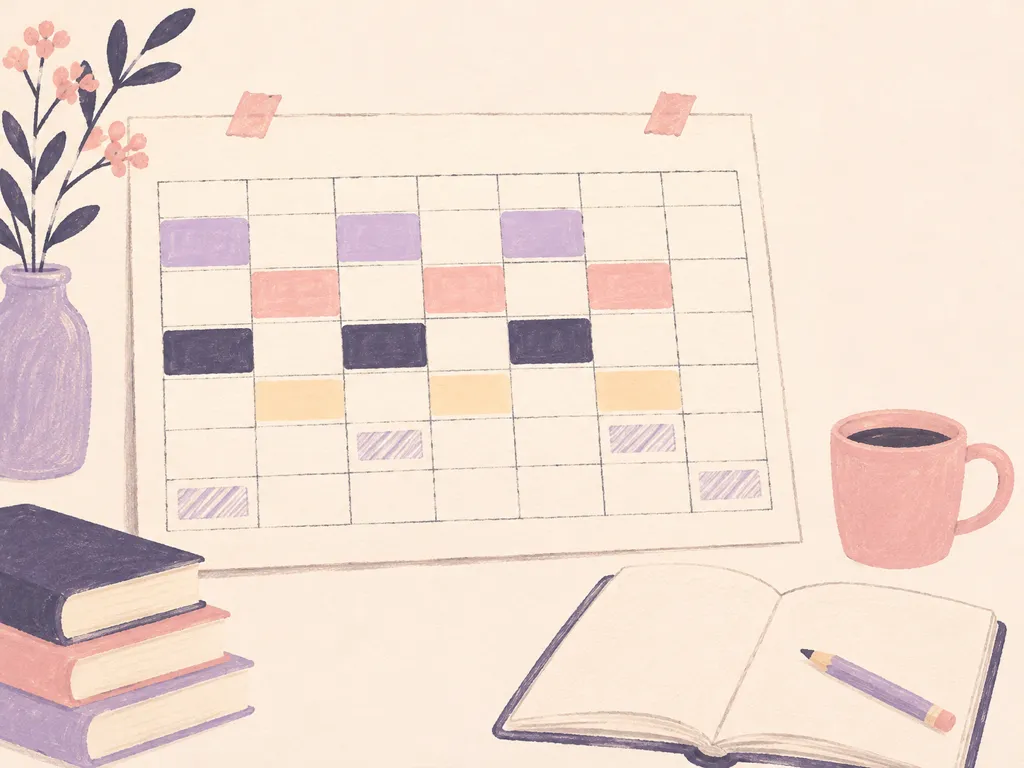
Use the same few steps each week, but change the tasks to match the courses and deadlines you have. This fictional example shows how a student with four classes might spread work across a week. The dates and task lengths are examples, not a recommended workload.
| Day | Course task | Planned time | If the day changes |
|---|---|---|---|
| Monday | Biology: draw one process from memory, then check the lecture notes | 30 min | Move to an open slot this week |
| Tuesday | History: outline the next discussion question from the assigned reading | 25 min | Break the outline into two parts |
| Wednesday | Statistics: try three practice problems and check each step | 35 min | Keep the missed problems on the list |
| Thursday | Biology: revisit Monday's missed steps and note one question | 25 min | Ask at office hours or in the course forum |
| Friday | History: compare the outline with the reading and add missing evidence | 30 min | Move only if the discussion date allows |
| Weekend | Check due dates and choose next week's tasks | 20 min | Do a shorter check on another day |
The routine has repeated points, not identical days. Biology appears twice so the student can return to the material after a gap. The Institute of Education Sciences' study guide recommends spacing learning over time. It also describes quizzing with retrieval as a way to support learning. That does not mean every student needs the same number of sessions or the same spacing.
Make a task small enough to restart
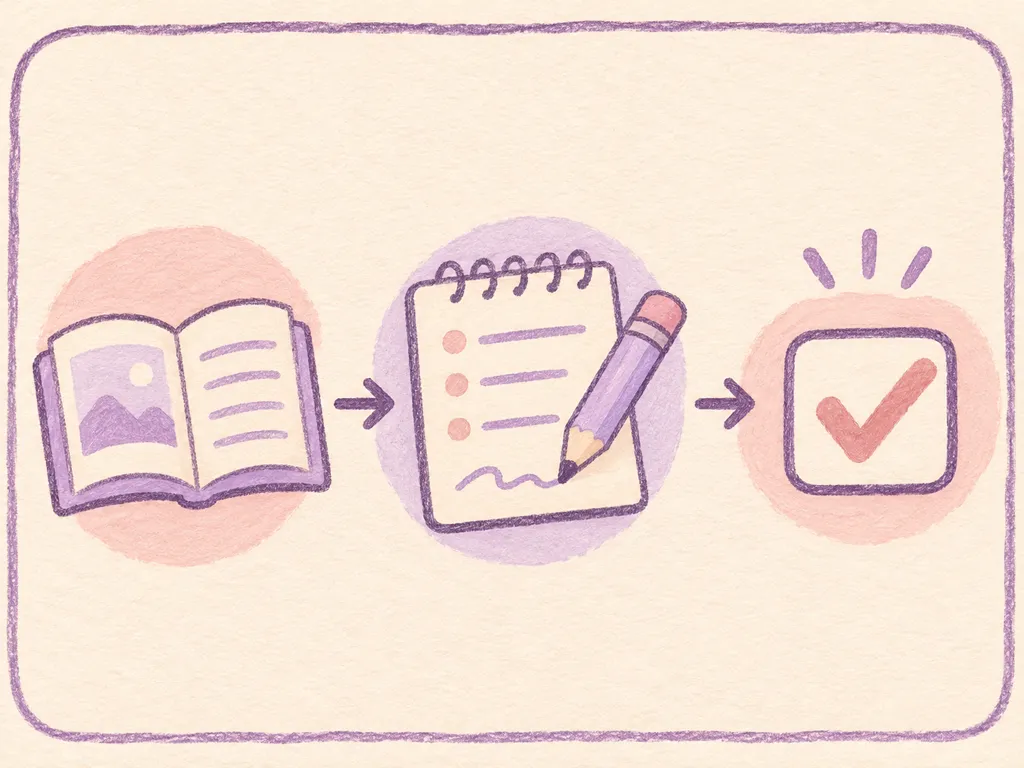
A useful task has a course, a source, a next action, and a finish point. If you miss it, you can move one clear item instead of carrying a whole subject into next week.
For example, “review the lecture” is hard to size. You might turn it into “read slides 8 to 12, list two terms I can't explain, and check the definitions in the notes.” For a problem-based class, try “solve problems 2 and 3 without looking at the worked example, then compare the steps.” Follow the methods your instructor expects.
This also makes it easier to tell two problems apart:
- Unfinished work needs a time or a smaller task. A reading not started may need a 20-minute first pass.
- Unclear material needs an answer or a source. A concept you can't explain may call for a worked example, office hours, tutoring, or a question in the course forum.
Those are different next steps. Rescheduling an unanswered question does not answer it. Keep the question visible and decide where you can get help. A task that moves twice deserves a change: shrink the task, find a source, or ask a person. Give it another date only after you know what will be different that time.
The What Works Clearinghouse review of retrieval practice covers one study in which students recalled information after reading a science passage. Its findings apply to that reviewed study, not every class or every study method. The practical idea is modest: sometimes close the notes and try to recall a concept, then check against your course source.
When a week slips, keep the parts that still matter
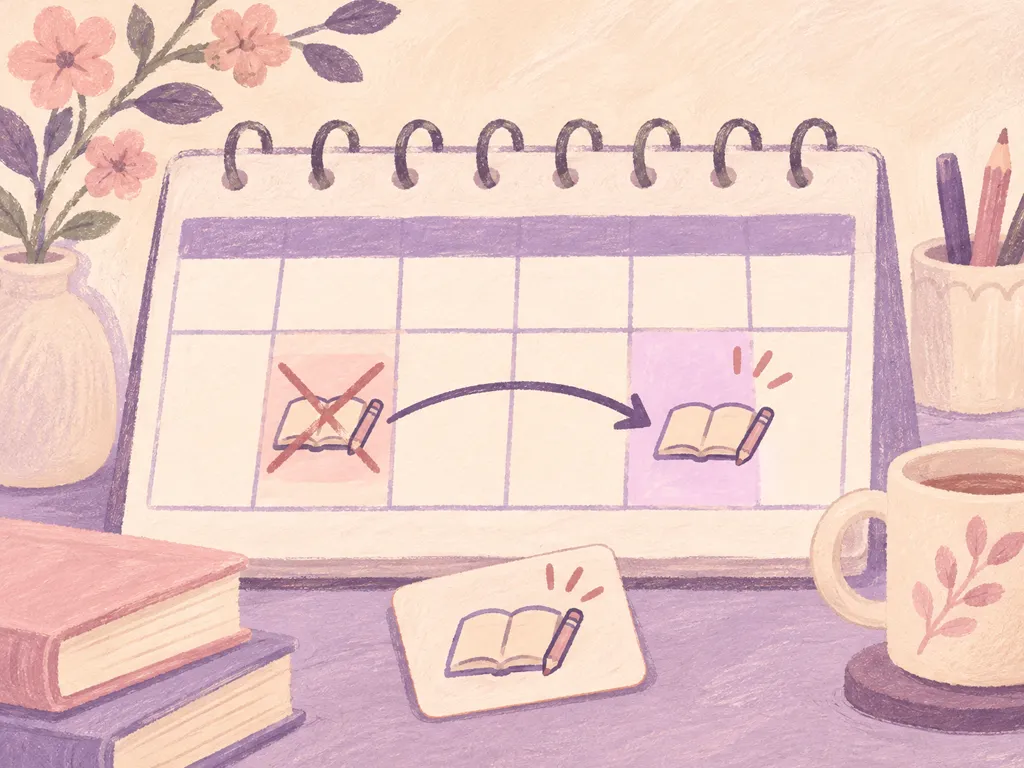
Missing a session is a scheduling problem to solve, not proof that you need a new system. First check the next deadline. Then ask whether the task still matters and whether it can fit somewhere before that date.
Use this quick reset:
- Keep the unfinished task visible. Don't let it disappear because the planned day passed.
- Choose a real opening. Check classes, work, meals, sleep, and other commitments before moving it.
- Reduce or replace the task if needed. Split a long reading, ask which topic to prioritize, or use course support for a confusing concept.
- Leave what no longer matters behind. If the task is finished another way or no longer applies, remove it from the current plan.
If you missed several days, restart with one check of your course pages and the next deadline. Choose the smallest useful task you can do now. You can do that reset on Monday, Thursday, or the day you notice you have fallen behind.
Try not to “make up” missed study time by stacking every task onto tomorrow. That can turn one change into an impossible day. The Learning Scientists' discussion of spaced and retrieval practice describes spreading study across time and using recall during sessions. It supports revisiting material, not cramming every missed task into one sitting.
How the Ultimate Student Planner handles this
The Study Plan tab in Ultimate Student Planner records planned time, done time, and sessions to reschedule. It can keep a weekly routine beside classes, assignments, the calendar, and the weekly planner in the same file. The Google Sheets and Excel planner with a Study Plan tab is one option if you want those details together.
The sample copy shows a filled-in semester, and the clean copy lets you start with your own information. A study plan template for one course shows how to give a topic a source, next action, date, and status. You can also use the same fields in a notebook or document.
The spreadsheet does not build a routine from your syllabus, import school portal dates, sync with a calendar app, or send reminders. It holds the details you enter. Confirm dates with your course pages and choose tasks using your instructor's guidance. If you already have a system you update, it may be all you need.
Use a short check-in to keep the routine useful
At the end of the week, spend a few minutes checking what happened. Mark finished tasks, move work that still matters, and remove tasks that no longer apply. Notice whether an estimate was far off, but don't treat one unusual week as a new rule.
For a task that keeps moving, change something before giving it another date. Make it smaller, find a source, ask a question, or drop it if the deadline has passed and it is no longer useful. A new date by itself does not make the task easier to start.
You can keep the check-in simple:
- What is due next?
- Which course task is clear enough to begin?
- What needs help or clarification?
- Where is there genuine room in the week?
If you don't have time for a full review, answer one question: what is the next useful thing to do? A routine is there to help you make that choice. You can rebuild it in a few minutes when your week changes.
General information, not medical advice.
Read the Cosmo Suite editorial policy or contact us with a correction.
Sources checked 3 Nov 2026: Institute of Education Sciences What Works Clearinghouse, “Organizing Instruction and Study to Improve Student Learning” and “Retrieval Practice Produces More Learning Than Elaborative Studying With Concept Mapping”; The Learning Scientists, “How Students Can Use Spacing and Retrieval Practice.”
Frequently asked questions
Does this study routine work for high school?
Yes. Start with the class schedule and deadlines your school gives you. Keep the plan small enough to check with a teacher, parent, or counselor if you need help fitting it around school and other commitments.
How many hours should I study each day?
There is no daily number that fits every student and course. Check your deadlines, course guidance, and available time. Choose a short task you can finish, then adjust after you see how long it takes.
What should a weekly study routine include?
Include fixed classes and commitments, a few specific study tasks, and open time for changes. Give each task a course, a source, a next action, and a date so you can tell what to do and what still needs a new time.
Should I study every subject every day?
Not necessarily. Use your course goals and deadlines to decide what needs attention this week. Spacing work across multiple days can help you revisit material, but your schedule does not need to repeat the same pattern for every class.
What if I miss a study session?
Keep the task visible, pick a real open time, and check that it still fits before the next deadline. If no time fits, reduce the task or ask your instructor what to prioritize. Do not pile it onto an already full day.
How do I restart a study routine after falling behind?
Take a short reset: check the next deadline, list what is unfinished and what is unclear, then choose one useful next action. Move only the tasks that still matter. You can restart on any day, even if Monday is your usual weekly check.
Can a planner spreadsheet make my study routine for me?
No. A spreadsheet can hold dates and tasks you enter, but it cannot decide what your course needs or import your school portal. Use your syllabus and instructor guidance to choose the work, then record it in a format you will update.
Sources
- Institute of Education Sciences What Works Clearinghouse: Organizing Instruction and Study to Improve Student Learning
- Institute of Education Sciences What Works Clearinghouse: Retrieval Practice Produces More Learning Than Elaborative Studying With Concept Mapping
- The Learning Scientists: How Students Can Use Spacing and Retrieval Practice
Keep reading

Study Methods and Exams
Study Plan Template for One Course: Topics, Dates and a Done Tick
Study plan template for one course: list topics, sources, dates and a done tick, then move unfinished work when your week changes. Adjust it weekly.
· 7 min read
Study Methods and Exams
How to Study for Finals: A Plan That Starts 3 Weeks Out
How to study for finals: use three weeks to sort course material, set weekly study goals, and make a plan that can change when your week does.
· 7 min read
