Active Recall: Practise One Class Without Notes
Active recall helps you check what you can produce from memory. Try it in one class with a prompt, a closed-book answer, and a careful check.
By Ultimate Student Planner by Cosmo Suite · Editorial policy
Published · 7 min read
To try active recall, close your notes and explain one topic from memory. Then compare your answer with the course material. Ultimate Student Planner is a Google Sheets and Excel planner by Cosmo Suite. Its student planner spreadsheet can keep a class, topic, and planned or completed study time together, while the recall attempt happens outside the file. You can use a blank page, a question, a diagram, or a problem. No special app is needed.
Put the answer out of sight until you have made an attempt. Rereading can make a page feel familiar, but that feeling does not tell you what you can retrieve with the source closed. The method below uses one biology-class example and a check step. Its example is illustrative, not a study timetable.
The Short List (TL;DR)
- Pick one topic from a class you have already studied.
- Write a question that asks you to explain, draw, or solve something.
- Close the notes and make an answer before checking.
- Compare your attempt with the course source, then name the gap.
Active recall starts when the answer is hidden
Active recall asks you to retrieve information from memory before you look at notes or a solution. Cornell's Learning Strategies Center describes retrieval practice as recalling concepts from memory and putting them on paper; its Blank Page Testing approach starts with a blank page. Write or say something before the source gives you a cue.
Reading still has a place. Use it to understand a new idea or repair something you missed. Then close the material and see what you can explain on your own. If you are looking at the answer while you copy it, you are reviewing information, not checking what you can retrieve without help.
A recall attempt can be short. Write a definition, draw a process, answer a prompt aloud, or work through a practice question. Choose a format that resembles what your class asks you to do. A rough answer is enough if you can compare it with the course source.
Active recall at a glance
Choose the kind of answer your class asks you to produce, then try it before checking.
| Method | What you do before checking | Best for |
|---|---|---|
| Blank-page recall | Write or draw what you remember with notes closed | A topic with connected ideas |
| One clear question | Answer a prompt in your own words | A concept, definition, or cause |
| Practice problem | Work the steps without looking at the worked solution | A class that asks you to apply a method |
| Explain it aloud | Describe the idea without reading a script | A process you need to explain |
Cornell's learning center calls one version Blank Page Testing. The University of Melbourne's exam-revision guide also recommends covering notes and trying to recall main points before checking. Pick one format to start. A page full of half-remembered details is still useful if you can check it and identify what needs attention.
Multiple choice can be less revealing when the answer choices are visible from the start. Seeing a familiar option may help you recognize it without producing it yourself. If you use a quiz, cover the options while you form an answer, then uncover them and check.
How to practise active recall in one class
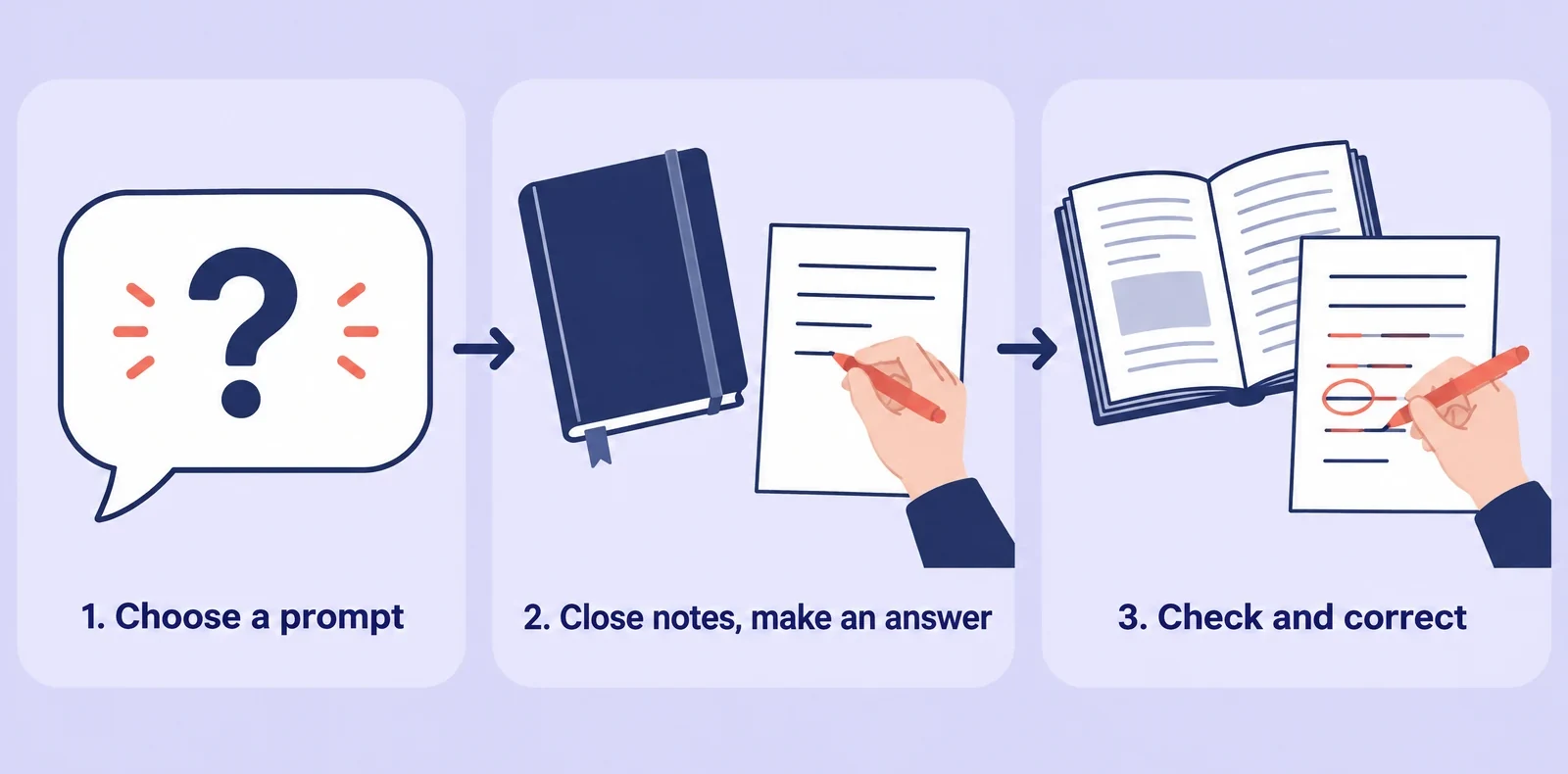
Choose one topic you have already studied. Make the answer before you check it so you can see what you recalled and what you needed to look up.
- Pick a small topic. Use a lecture concept, a section of a reading, or a type of problem. A broad prompt such as “What did we learn in biology?” is hard to check. A question about one process or relationship gives you a clearer target.
- Write a prompt before closing your notes. Ask for something you can verify: “What are the stages in this process?” or “Why does this result follow from that rule?” Keep the answer out of sight. If the question is vague, rewrite it before you begin.
- Make an answer from memory. Write a few sentences, sketch and label a diagram, explain it aloud, or solve a problem. Leave gaps visible. Do not pause to search for a perfect phrase or open another tab to fill a blank.
- Check against the course source. Compare your answer with the lecture notes, assigned text, instructor's practice problem, or another source your course trusts. Mark what was correct, missing, or mistaken. Then fix the specific gap.
The University of Cincinnati's study-skills guide describes a similar sequence: review material, put it away, recall, check, and correct. A fluent answer can still miss a detail, while a rough answer may already contain the main idea. Compare it with a reliable source instead of judging it by how polished it sounds.
A worked week in one biology class
Consider a fictional biology course that introduces three related topics during the week. The table shows a possible recall prompt for each one, an answer format, and what to check. The prompts and student responses are illustrative.
| Class topic | Recall prompt | Attempt before checking | What to compare |
|---|---|---|---|
| Cell membrane | “Explain how a substance moves across the membrane in this example.” | Draw the membrane and describe the movement in words | The process and labels in the course notes |
| Cell signaling | “What event starts the sequence described in today's notes?” | Write the steps in order from memory | The order and terms used in the lecture |
| Cell division | “What changes between the two stages we compared?” | Make a short side-by-side sketch | The features highlighted in the assigned material |
The student can start without a set of flashcards. Each attempt uses a course idea and a checkable answer. If the drawing misses a label, add it after comparing the notes. If the steps are out of order, correct them and explain why the order matters.
Use the terms and examples your instructor provided. If you write your own prompt, check that it matches the lesson and asks about material your course has covered.
How the Ultimate Student Planner handles this
The Study Plan tab in Ultimate Student Planner has fields for date, class, topic, planned time, done time, and a completion tick. Use them to record the course topic and whether you completed the session. The sheet does not create recall questions or check your answer; make the attempt and compare it with your class materials.
A Google Sheets and Excel study planner may suit you if you want those session fields beside other class information. A paper page, document, flashcard set, or course tool works too.
The product includes a sample copy and a clean copy. The sample shows the fields in use; the clean copy is for a student's own courses. It records study sessions but does not connect to a school portal or provide course material.
Turn a checked answer into a useful next step
After checking, name the gap. Review a missing term. Revisit the explanation and redraw a sequence you got wrong. If your outline is right but lacks an example, write a more specific question for your next attempt. “Study it again” does not tell you what to do.
Keep your source close while you check. Cornell's practice-exam guidance recommends using practice tests under conditions similar to the real exam and then reviewing what the attempt shows. For an ordinary class topic, the same idea can be scaled down: use a question that fits the course, attempt it without notes, and compare the result with the relevant material.
If an answer is wrong, use the source to correct it before you try again. When the course source is unclear, check the assigned text or ask your instructor or teaching assistant. Your class materials set the expected terms and method.
Common mistakes that blur the result
Watch for these habits that can hide what you actually recalled:
- Looking too soon: If the prompt and answer stay visible together, your eyes can do the work. Hide the answer until you have made an attempt.
- Choosing a huge topic: “Explain the whole unit” produces a long, hard-to-check response. Use one concept or problem type, then widen the question if the first one is clear.
- Treating every omission alike: Missing a label differs from using the wrong concept. Mark the difference so you know what to correct.
- Checking against memory alone: Your own feeling of confidence is not a source. Compare with notes, the assigned reading, or a verified answer key.
- Using recall before understanding the material: If the topic is new, read or listen to the lesson first. The retrieval attempt checks what you have learned so far.
The University of Melbourne describes covering notes and retrieving key points as one active-learning approach. Cornell's learning center says retrieval can show what you do and do not understand. Use that information to choose what to review; it is not a grade or an exam prediction.
A student planner guide can help you organize course information before planning your next session.
Sources checked 24 Oct 2026: Cornell University Learning Strategies Center, “Effective Study Strategies” and “What To Do With Practice Exams”; University of Melbourne Academic Skills, “Exam revision”; University of Cincinnati Online, “Study Skills.” Read the site's editorial policy or contact the team with a correction.
Frequently asked questions
Does active recall work for high school students?
Yes. A high school student can close the notes, answer a question from memory, and then check the answer against class materials. Choose a topic and question that match the course.
What is active recall in simple terms?
Active recall means trying to bring information to mind without looking at the answer first. You can write, speak, draw, or solve, then compare your attempt with a reliable course source.
Is active recall better than rereading?
They do different jobs. Rereading can help when you are first learning or correcting a gap. Active recall checks what you can produce after the material is put away.
Do I need flashcards to use active recall?
No. A question on paper, a blank page, a diagram from memory, or a practice problem can work. The key is to make an answer before you look at the solution.
How long should I use active recall?
There is no single session length for every class. Pick one manageable topic and stop to check your answer against the course material before deciding what needs more work.
Can active recall help with math or science?
Yes. Try to solve a problem or draw a process without looking at a worked answer, then compare each step with your class source. Follow the method your instructor expects.
Is active recall the same as spaced repetition?
No. Active recall describes how you try to retrieve information. Spaced repetition concerns when you return to it. This guide focuses on the recall attempt and its check.
Sources
Keep reading
Student Planners
Student Planner: What It Should Hold for Each Class (Paper, App or Spreadsheet)
Student planner setup for one semester: what to keep for each class, how paper, apps and a spreadsheet compare, and a routine to restart after a bad week.
· 10 min read
Student Planners
Student Planner Template: The 9 Parts a Semester Actually Uses
A student planner template with nine parts for class details, due dates, a weekly plan and grades. See how to build a setup you can restart after a missed week.
· 8 min read
Student Planners
Class Schedule Template: Monday to Sunday, Each Class in Its Colour
class schedule template: organize weekly meetings by day, time, class and room, then see where a spreadsheet fits. Build a clear timetable you can update.
· 7 min read
